
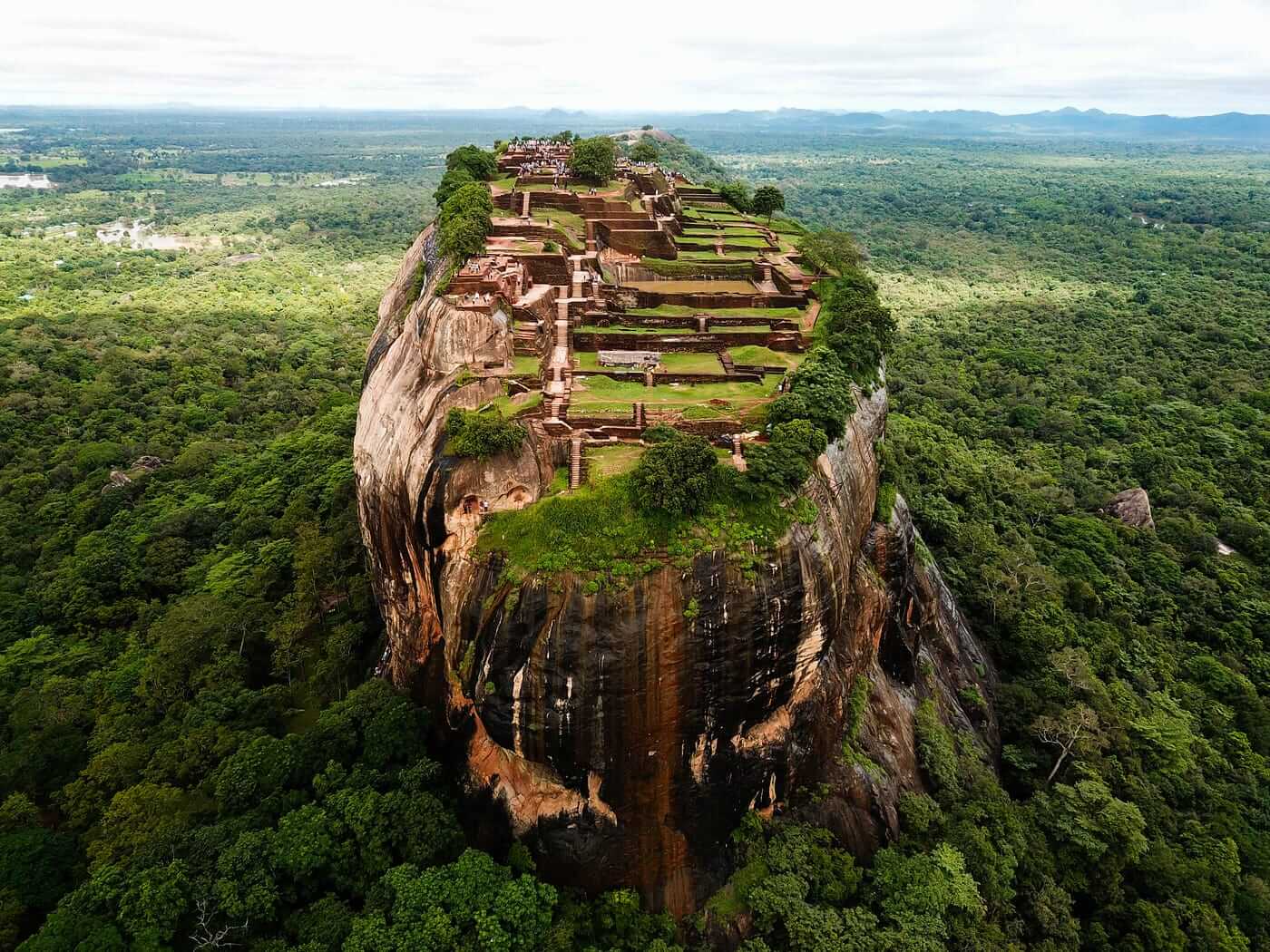
At first light in the North Central dry zone, Sigiriya rises out of the palm canopy like a rust-red whale breaching an emerald sea. The air smells of warm rock and wild jasmine carried from home gardens in nearby Kimbissa. Mynas chatter in the moatside kumbuk trees, and somewhere a distant temple bell answers them. By the time the ticket gates clink open, a soft mist is lifting off the water gardens and the great Lion Rock is already blushing gold. I’ve climbed Sigiriya more times than I can count, yet each ascent still feels like a conversation with something ancient and alive—half fortress, half fever dream—etched into our island’s memory.
History & Heritage
We call it Sinhagiri—Lion Rock—though the name “Sigiriya” has long taken root. The story that pulls most visitors here is part palace intrigue, part poetic legend. In the 5th century, Prince Kashyapa seized the throne after a bloody power struggle, then fled the old capital of Anuradhapura to build his new citadel in the clouds. He chose this colossal magma plug as his refuge, fashioning a royal city at its base and a sky palace on the summit, guarded by the stylized claws of a lion.
From Monastery to Royal Citadel
Before Kashyapa, hermit monks had already made the rock’s caves their meditation cells. You can still see the drip-ledges they carved to keep rain from their shelters, and if you pause in those shadowed alcoves you’ll hear what the wind carries—birdsong, the far-off bark of a toque macaque, and your own breath. After Kashyapa’s fall, Sigiriya likely returned to monastic life. Time rubbed away its royal sheen, but the bones of genius remained: a city planned with impeccable symmetry, with hydraulic marvels that coaxed pleasure gardens from a harsh dry zone.
The Frescoes and the Mirror Wall
Midway up, the rock’s western face once shimmered with hundreds of frescoes—apsaras, the “cloud maidens”—painted with mineral pigments that glow even now: copper reds, mango golds, and a green like deep river shade. Only a handful survive, but stand quietly and you may feel the painters’ hands still moving. Below them stretches the Mirror Wall, once polished with lime and egg whites to reflect the king’s procession. Later, visitors chiseled verses into it—love notes to the painted women and to the landscape itself—some of Sri Lanka’s oldest “graffiti poetry,” fierce, funny, and tender all at once.
UNESCO Recognition and Local Lore
Sigiriya’s UNESCO listing is about architecture, art, and engineering, but ask a villager and you’ll also hear about omens, guardian spirits, and jackfruit-sweet childhood hikes. That blend of the monumental and the intimate is Sigiriya’s true charm: it is at once a world masterpiece and a place where schoolkids chase each other along irrigation bunds after class, where farmers pause their bicycles to watch the rock turn amber at dusk.
How to Get There
By Road
From Colombo, it’s a 4–5 hour drive via Kurunegala and Dambulla, entering the scrubby green of the dry zone as paddy fields spread flat to the horizon. From Kandy, expect 2.5–3 hours through Matale’s spice country and coconut estates. Polonnaruwa is a scenic 1.5-hour hop, and Trincomalee’s coast sits about 2.5 hours away. Self-drivers will find clear signage after Dambulla; otherwise, private cars and ride-hailing or hotel transfers are easy to arrange.
By Bus and Train
Long-distance buses run frequently to Dambulla. From there, hop a local bus or tuk-tuk for the final 30–40 minutes to Sigiriya village. The nearest train station is Habarana; the line doesn’t take you all the way, but a 20–30 minute tuk ride will. Trains are slower yet atmospheric—open windows, cinnamon-scented air, and vendors selling vadai and peanuts at halts.
By Air
Seasonal domestic flights sometimes operate to the Sigiriya airstrip, a few minutes from the rock. It’s a splurge, but the bird’s-eye view of the lion’s outline and its green moat is unforgettable.
What to See and Do
Start at the Water Gardens
Walk the arrow-straight processional path where Kashyapa staged his royal entries. Early morning, the shallow pools are mirrors, reflecting lotus leaves and the rock’s prow. The hydraulic channels still gurgle to life in the rains—an ancient engineering trick that never fails to impress. Pause by the stone sluices, cool to the touch, and trace the cleverness that fed fountains with nothing but gravity.
Through the Boulder Gardens
The path narrows between hulking granite boulders. Here, the citadel turns intimate: cave shrines with fading ochre marks; the Cobra Hood Cave with its serpent silhouette; and the Audience Hall, imagined from the way steps cascade over rock like a royal carpet. The smell changes too—dusty rock, wild neem leaves, sometimes a whiff of woodsmoke from a distant hearth.
The Apsara Frescoes
A spiral staircase clings to the rock, its rungs ringing lightly underfoot. At the top, the fresco gallery glows. These women—sweetly smiling, arms heavy with flowers—float against a green-blue dusk. Photography here is restricted (and enforced), so pocket the camera and look. The longer you gaze, the more you see: a line of a wrist, a mischievous half-smile, the powder-soft shading on a cheek. It’s intimate, human, and startlingly modern.
The Mirror Wall
Along the Mirror Wall walkway, run your fingers near—but not on—the glossy surface and imagine the king’s reflection riding past. Etched verses, some over a thousand years old, speak in a chorus: “I came alone; I have gazed at the cloud maidens; now my heart is full.” Turn around here for a favorite mid-level panorama—over palms and tank-stitched fields all the way to the hazy blue of Ritigala.
Lion Terrace and the Summit
The Lion Gate appears slowly, first a sense of scale and then the paws themselves, monumental, toes smooth from centuries of touch. Between them, an iron stairway climbs the final face. The wind picks up; the rock breathes hot under hand. From the summit, the palace plan squares itself: the royal pool like a skyborne lake; terraced gardens; a throne-like seat where the breeze never quite stops. On clear days, Pidurangala’s lower hump frames the lion from the north, and you see villages stitched to tanks in a lattice of silver and green. Bring silence with you—it fits this place better than words.
Sigiriya Museum and Village Flavors
Don’t skip the museum near the western entrance. Its models help decode what the ruins suggest, and the cool galleries are a relief after the climb. Afterwards, sip a king coconut in the shade, or try buffalo curd with kithul treacle from a roadside stall—tangy, smoky-sweet, and exactly what tired legs need.
Best Viewing Points
If you want the shot that lives in your mind long after you’re home, aim for these: the western moat at first light, when the rock’s reflection sits perfectly still; the Lion Terrace, where the paws frame the stairway and sky; the Mirror Wall walkway, looking back over the water gardens in tidy geometry; and the summit’s northwest corner, where sunset turns Pidurangala and the plains honey-bronze. For the ultimate postcard, climb Pidurangala itself at sunrise and watch Sigiriya float on a bed of mist like a ship under full sail.
Best Time to Visit
Sigiriya is climbable year-round, but seasons flavor the experience. The dry months from June to September and January to April offer the steadiest weather. October to December brings afternoon squalls and greener gardens; the rock can be slick then, but the cloud drama is cinematic. Midday in March and April can be punishingly hot—start at opening time (around 6:30 a.m.) or after 3 p.m. for kinder light and kinder temperatures. Weekdays are quieter than weekends and poya (full moon) days. If you’re pairing Sigiriya with the wild elephant gatherings at Minneriya or Kaudulla, target July to September when herds congregate as water recedes.
Practical Information
Opening hours typically run from 6:30 a.m. to 5:30 p.m., with last entry in late afternoon—arrive early to avoid queues and heat. Allow 2.5 to 4 hours for a relaxed visit. Foreign adult tickets are in the range of USD 30–35 and usually include museum access; rates change, so check the official site or your hotel for current fees. Card payments are often accepted, but carry cash in case of outages.
The climb involves around 1,200 steps with narrow staircases and some exposure; folks with vertigo will want to pace themselves and use the railings. There are no toilets on the rock—use facilities at the base or museum. Carry at least a liter of water per person, sun protection, and sturdy shoes with good grip. Note that photography is prohibited in the fresco gallery; elsewhere it’s fine. Drones require official permits and are not generally allowed. During wasp season, sections may be temporarily closed; rangers sometimes hand out protective veils if colonies are active—follow their guidance without debate.
Guides can be hired at the entrance and are excellent at illuminating details you might miss, from faint carvings to irrigation channels. Tipping is customary; agree on a rate beforehand. Sigiriya is not a temple, so there’s no dress code—but Sri Lanka appreciates modesty. Shoulders and knees covered will also help with sunburn. Keep a respectful distance from monkeys and don’t feed them; they’re clever thieves with a taste for biscuits and bravado.
Nearby Attractions
- Pidurangala Rock: A wilder, less-manicured climb just north of Sigiriya. Sunrise paints Sigiriya a soft apricot while incense curls from shrines below. Expect a short cave-temple section and a final scramble over boulders.
- Dambulla Cave Temple (Golden Temple): A 30–40 minute drive brings you to a honeycomb of rock caves filled with Buddha statues, mural ceilings, and the perfume of frangipani. Climb barefoot—stone cool in the morning, warm by noon.
- Minneriya and Kaudulla National Parks: Seasonally, hundreds of elephants gather on the grasslands around ancient reservoirs. Late afternoon safaris give you cinnamon light, trumpeting calves, and bee-eaters skimming the tanks.
- Polonnaruwa Ancient City: Meditative ruins sprawled across a green plain—moonstones, royal baths, and the serene stone Buddhas at Gal Vihara. Rent a bicycle and let the wind do the storytelling.
- Ritigala Forest Monastery: Mossy steps vanish into jungle, and silence sits thick as velvet. A monk’s world of austerity, ferns, and filtered light—best for slow walkers and seekers.
- Habarana Lake and Village Walks: Paddle a catamaran through lily pads, watch fishermen cast nets at dusk, and finish with a home-cooked rice-and-curry served on banana leaves.
Travel Tips
Climb Early, Breathe Slowly
Be at the gate a few minutes before opening. You’ll share the garden paths with peacocks, not tour buses, and the light will flatter every photograph. Take the ascent in sections; there are enough ledges and platforms to catch your breath and your thoughts.
Choose Your Entrance
The western entrance is closest to the water gardens and the museum, ideal for a first-timer who wants the grand approach. The southern approach through the boulder gardens is shadier and moodier.
Mind the Rules, Guard the Beauty
No touching the fresco walls, no carving your own verse into the Mirror Wall, and no drone buzzing the peace. These seem obvious, but reminders are printed for a reason. Leave only footprints, and even those, as light as you can.
Hire Local Eyes
A licensed guide can make the site breathe—pointing out half-erased moats, reading stone the way some read palms, and weaving in stories from village lore. Ask for a guide who balances history with quiet time; the rock rewards silence too.
Hydrate and Shade Up
The dry zone sun means business. A hat, sunscreen, and a refillable bottle are essentials. Refill at your hotel or with purified water; avoid single-use plastics if possible—Sigiriya’s beauty is shared, and so is its stewardship.
Respect the Bees
If rangers signal a wasp alert, comply. Loud noises and clapping can trigger swarms; keep voices low through sensitive zones. It’s part of sharing space with the rock’s older inhabitants.
Conclusion
On the way down, when the heat has softened your muscles and the plains open like a page, Sigiriya feels less like a conquest and more like a conversation you were lucky to join. The lion’s paws shrink behind you; paddy birds stitch slow white lines across the sky; a child laughs somewhere by the moat. You’ll carry the summit’s wind in your hair and the frescoes’ color behind your eyes, but also something quieter—the knowledge that grandeur can live with grace, that a fortress can become a poem, and that in Sri Lanka, stone itself remembers. Come early, climb gently, linger long. The rock will tell you the rest.
Continue Reading
-
Kandy Travel Guide: Cultural Sites, Temples & Hidden Gems
Kandy isn’t a city you simply tick off a list—it’s a place you feel in your bones. Mist threads the…